
Home > About > History > Parliament in Ireland > Seanad and President

The First Seanad (1922)

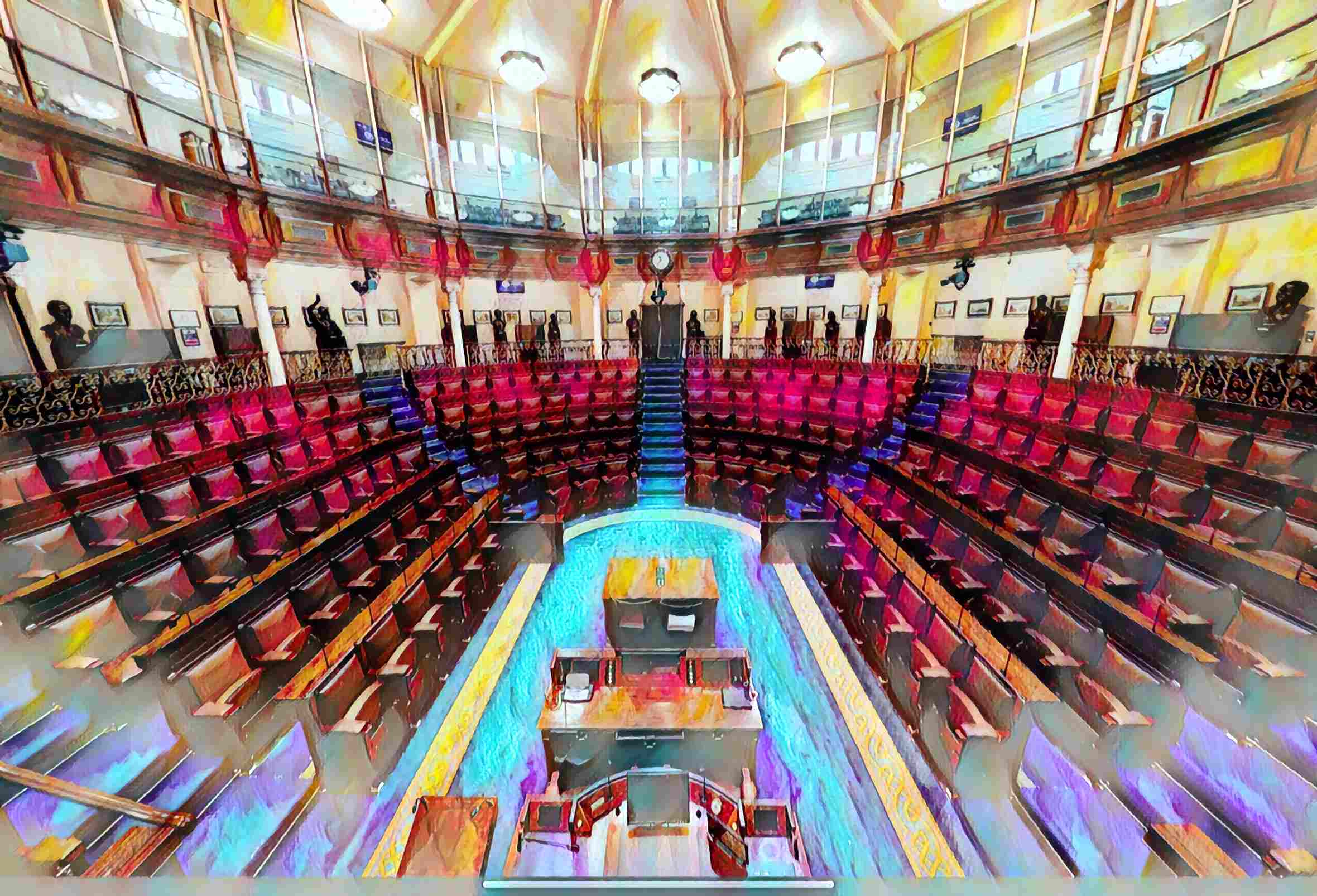
The pre-Union Irish Parliament consisted of an Upper and a Lower House, the House of Lords and the House of Commons. The Home Rule Bills of the 19th and early 20th centuries also provided for a bicameral legislature. This was continued in the Government of Ireland Act 1920 which provided that the Senate, the Upper House of the Southern Ireland Parliament, should consist of 64 members. Elections to this House were held in 1921 at the same time as the elections to the Lower House. The Dáil however refused to recognise these elections.

The Irish Free State Constitution of 1922 provided for the establishment of a second parliamentary chamber – Seanad Éireann (Senate) – consisting of 60 members. The Constitution provided that the Seanad should be composed of citizens who had done honour to the nation by reason of useful public service or who, because of special qualifications or attainments, represented important aspects of the nation’s life. While the Seanad was to be directly elected by the people, as a transitional measure one-half of the first Seanad was nominated by the President of the Executive Council and the other half was elected by the Dáil.
The General Election was held on 7 December 1922, and the Seanad of the Irish Free State met for the first time on 11 December 1922.

The functions and powers of the first Seanad were modelled on those of the British House of Lords. Substantial changes were made to these in subsequent years and the election process was also amended. The first, and last, direct election took place in 1925, as provided for in the constitution. The choice of the electorate was limited to a panel of candidates nominated by the Dáil and Seanad. Following the recommendations of the Joint Committee on the Constitution of Seanad Éireann in 1928, the electoral system was changed with the electorate now consisting of the members of the Dáil and the outgoing senators. The Triennial Periods commenced on 6 December 1922, 6 December 1925, and so on. Triennial elections were held in 1922, 1925, 1928, 1931 and 1934.

Office of Governor-General (Seanascal) (1922)

Article 60 of the Irish Free State Constitution created the office of Governor-General: "The Representative of the Crown, who shall be styled the Governor-General..." Holders of the office were Tim Healy (1922 - 1927), James MacNeill (1927 - 1932), and Domhnall Ua Buachalla (Donal Buckley) (1932 - 1936).

Abolition of the Seanad (1936)

Following somewhat unsatisfactory relations between the two Houses over a number of years serious conflict developed after the change of government in 1932. Legislation to remove the oath required to be taken by Members of the Oireachtas, as laid down in Article 17 of the 1922 Constitution (commonly referred to as the Oath of Allegiance), was opposed by the Seanad and its enactment postponed for almost a year. The oath was eventually removed from the Constitution by the Constitution (Removal of Oath) Act 1933 on 3 May 1933.

Having rejected later Bills, the Seanad, as it then existed, was abolished on 29 May 1936 under the Constitution (Amendment No. 24) Act 1936. The final sitting was held on 19 May 1936.

Abolition of the Office of Governor-General (1936)

The office of Governor-General was abolished by the Constitution (Amendment No. 27) Act 1936 on 11 December 1936 (see also the Executive Powers (Consequential Provisions) Act 1937). The amendment also deleted all references to the king in the Constitution. The amendment added a provision where once a bill was passed the Chairman of Dáil Éireann shall sign the bill "... and the same shall become and be law as on and from the date of such signature".
The Oireachtas enacted the Executive Authority (External Relations) Act 1936 on 12 December 1936 which stated that "... which for the purposes of the appointment of diplomatic and consular representatives and the conclusion of international agreements, the king so recognised may, and is hereby authorised to, act on behalf of Saorstát Éireann for the like purposes as and when advised by the Executive Council so to do." The Act also gave effect to the instrument of abdication executed by King Edward the Eighth.

Constitution of Ireland (1937)

The Irish Free State Constitution remained in force until it was replaced by the Constitution of Ireland, which was passed by the Dáil on 14 June 1937, adopted by the people in a plebiscite on 1 July 1937, and came into operation on 29 December 1937. In accordance with Article 51, the Constitution could be amended by ordinary statute for three years following the first President's entry into office. Since 25 June 1941 the Constitution may only be amended by referendum.
Article 4 states that the name of the State is Éire, or, in the English language, Ireland. Article 5: "Ireland is a sovereign, independent, democratic state."

Article 15 states that "The National Parliament shall be called and known, and is in this Constitution generally referred to, as the Oireachtas." and that "The Oireachtas shall consist of the President and two Houses, viz.: a House of Representatives to be called Dáil Éireann and a Senate to be called Seanad Éireann ... The sole and exclusive power of making laws for the State is hereby vested in the Oireachtas: no other legislative authority has power to make laws for the State."
Article 28 5 states that "The head of the Government, or Prime Minister, shall be called, and is in this Constitution referred to as, the Taoiseach."

The Second Seanad (1938)

The period of unicameral legislature was short however. When the new Constitution was being drafted the Executive Council appointed a Commission – Second House of the Oireachtas Commission – in June 1936 to "consider and make recommendations as to what should be the functions and powers of the Second Chamber of the Legislature in the event of its being decided to make provision in the Constitution for such Second Chamber.….". Following the report of the Commission, the Constitution of Ireland provided for the establishment of a Seanad more firmly under the control of the government. The general election for the new Seanad took place on 28 March 1938 and the first sitting was held on 27 April 1938.

President of Ireland (1938)

Dubhglás de Híde (Douglas Hyde, nom de plume "An Craoibhin Aoibhinn") was inaugurated as the first President of Ireland on 25 June 1938.

Republic of Ireland Act 1948 (1949)

The Republic of Ireland Act 1948 ( which came into operation on 18 April 1949 - S.I. No. 27/1949 ) repealed the Executive Authority (External Relations) Act 1936, and stated that "The President, on the authority and on the advice of the Government, may exercise the executive power or any executive function of the State in or in connection with its external relations." This severed the final link with the British Monarchy. The Act also stated that the description of the State is Republic of Ireland, but the name of the State remains Ireland in accordance with Article 4 of the Constitution.